
🤖 AI Expert Verdict
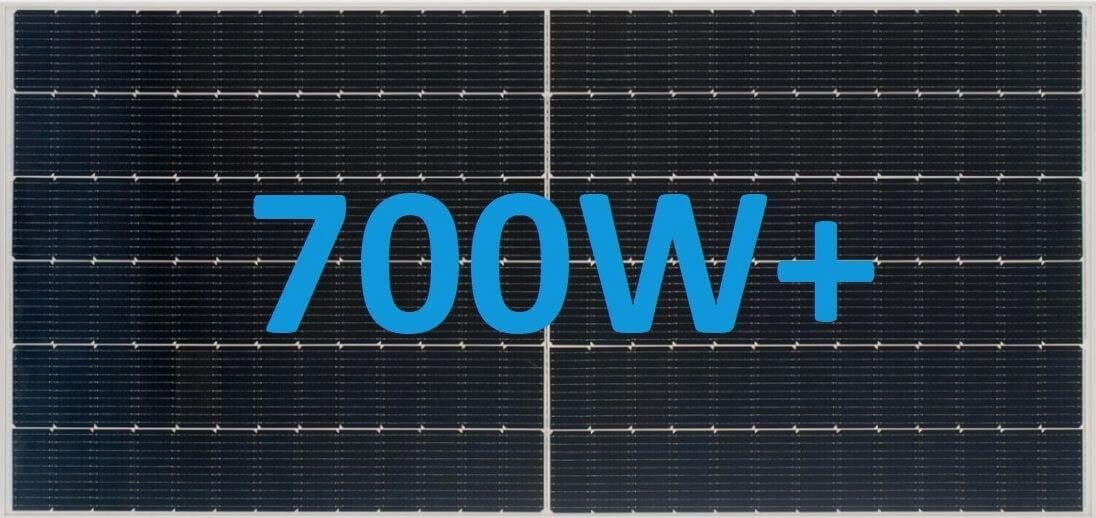
Manufacturers are rapidly developing high-wattage solar panels, with leading models now exceeding 750W for utility-scale applications. This power leap is driven by larger N-type wafers (182mm, 210mm), advanced cell structures like TOPCon and HJT, and high-density interconnection methods designed to reduce costs (LCOE) and maximize energy density on large solar farms.
- Lowers Levelized Cost of Energy (LCOE) for large projects.
- Higher energy density per square meter.
- Utilizes advanced N-type, HJT, and TOPCon cell technologies.
- Reduces installation costs per kW for solar farms.
The Race for Power: The World’s Most Powerful Solar Panels (750W+)
Solar panel efficiency remains vital. However, utility-scale solar focuses on maximum power output. The race for the world’s most powerful solar panel accelerated since 2020. Innovations in cell design drive this quick growth. We see larger N-Type cells and multi-busbar designs. These changes boost overall wattage significantly.
Trina Solar introduced a 600W module in 2020. This started the industry sprint. JinkoSolar and Canadian Solar quickly followed suit. They released new modules in the 600–670W range. By 2023, N-type TOPCon and HJT technologies dominated. Certified outputs moved past 700W. Today, panels commercially available near 750W. Test modules already exceed 760W. Several major manufacturers target 800W+ in the next two years. Shop Our Products to see the latest residential panels now available.
Why Solar Panel Power Is Increasing
A key factor in this power leap is the larger wafer format. Manufacturers use M10 (182mm) and G12 (210mm) sizes. Companies adopt oversized cell layouts. This optimizes module efficiency. It greatly increases energy density. New back-contact (BC) and zero-busbar (0BB) architectures also help. These innovations reduce Balance-of-System (BoS) costs. They improve the overall energy yield per square meter.
Driving Down Costs with Higher Wattage
Manufacturers develop larger, more powerful panels for one reason. They want to decrease solar farm costs. Ultimately, this lowers consumer electricity prices. Larger panels require the same connections as smaller ones. This means the installation cost per kW drops. The result is a lower Levelized Cost of Energy (LCOE).
You may want ten 700W panels on your home. You will be slightly disappointed. Most high-powered panels target commercial use. They are for utility-scale systems only. These extra-large panels are difficult to handle. They are not compatible with most residential rooftops.
The Current Leaders Pushing Past 750W
The utility industry continues favoring large, high-wattage modules. The leading edge now pushes beyond 750W. Early leaders like Trina Solar paved the way. Now, a new wave of manufacturers leads the race. Huasun Solar, TW Solar (Tongwei), and Jolywood are in the spotlight. They announced panels exceeding 700W. They utilize cutting-edge N-type TOPCon and HJT technologies.
Huasun Solar took an early lead. Their Himalaya G12-132 HJT module reached 750.54W. It boasted an impressive 24.16% efficiency. This was independently certified in 2023. They later achieved a 768.9W HJT module record. TW Solar responded with their TWMNF-66HD module. It uses a second-generation TOPCon cell structure. It achieved a 765W output. Mass production above 760W is expected by 2026.
Future Innovations and Record Breakers
New hybrid cell technologies push boundaries further. Lab-based modules already exceed 800W. Efficiencies are reaching 25% or higher. Trina Solar recently announced a massive breakthrough. They tested an 829W tandem module. It combines perovskite and silicon. This setup achieved a record 30.6% efficiency. This proves hybrid architectures can dramatically boost output.
LONGi set a new standard for commercial modules. Their new HIBC series uses back-contact technology. This delivers over 700W in mass production. It achieves a 25.9% efficiency rating. This high-density panel signals a new era. We now see 25%+ efficiency in commercial solar.
Despite these records, production above 730W is still limited. Manufacturers focus on scaling up capacity now. We focus on certified models for this list. These panels signal the future of solar power. Read Our Blog for more industry insights and clean energy updates.
Technical Advancements Enabling High Power
Panel wattage increased due to physical size and cell efficiency. New panels can measure 2.4m high by 1.3m wide. This is 20–30% larger than traditional panels. This naturally boosts the power rating.
Key Technologies:
- N-Type Silicon Substrates: They offer lower degradation rates (LID/LeTID). They tolerate metal impurities better.
- TOPCon (Tunnel Oxide Passivated Contact): This improves rear-side passivation. It enables higher open-circuit voltages.
- HJT (Heterojunction): This combines silicon with thin-film layers. It gives superior temperature performance.
- MBB (Multi-busbar): More busbars (9BB to 18BB+) reduce resistive losses. They improve current collection.
- High-Density Interconnection: This removes the gap between cells. It maximizes the active surface area.
The industry is moving toward standardizing 700W+ modules. Organizations promote agreed-upon industry dimensions. This effort improves the supply chain. It also aims to further lower the LCOE.
Reference: Inspired by content from https://www.cleanenergyreviews.info/blog/most-powerful-solar-panels.