🤖 AI Expert Verdict
Battery storage assets can be placed either Front-of-Meter (FTM), often connected to the distribution network or generation sources, or Behind-the-Meter (BTM), typically co-located with a business or home load. BTM assets often maximize value by reducing the owner's network charges, while FTM assets target wholesale market arbitrage and grid support. Location, market jurisdiction (like NEM vs WEM), and specific operational focus significantly determine which configuration yields the highest commercial return.
- BTM systems significantly reduce high network charges (30-60% of bills).
- FTM batteries are often larger and more cost-efficient for large-scale deployment.
- BTM assets focused on network support experience less workload and degradation.
- FTM assets in volatile markets (NEM) capture high wholesale arbitrage value.
Battery Storage: FTM vs BTM – Maximizing Commercial Value
Energy experts constantly debate battery storage placement. Where should we locate these assets? We must find the location that creates the greatest value. Value goes to both asset owners and the wider society. Generally, storage placed further downstream accesses more value streams. This means potential commercial returns increase.
Understanding Behind-the-Meter (BTM) Storage
BTM storage systems sit behind the electricity meter. They are co-located with a home or business load. BTM batteries offer a major benefit to owners. They significantly reduce exposure to network costs. Network charges often make up 30% to 60% of a typical bill. These assets still provide upstream services. These services include wholesale market arbitrage and frequency management. Market access and physical limits add complexity here.
We invite you to Read Our Blog for more insights on energy efficiency.
Understanding Front-of-Meter (FTM) Storage
FTM storage takes many forms. It often co-locates with solar or wind farms. This pairing helps ‘firm up’ generation supply. FTM assets can also sell energy during higher market prices. Sometimes FTM storage acts as an alternative to building new transmission networks. A key use case involves direct connection to local distribution networks. These batteries provide localized network support. They offer a flexible way to upgrade the low voltage (LV) network. When they are not supporting the network, they capture market value. Importantly, FTM assets can be larger. They are often more cost-efficient than smaller residential BTM cousins.
Commercial Returns: WEM vs. NEM Simulation
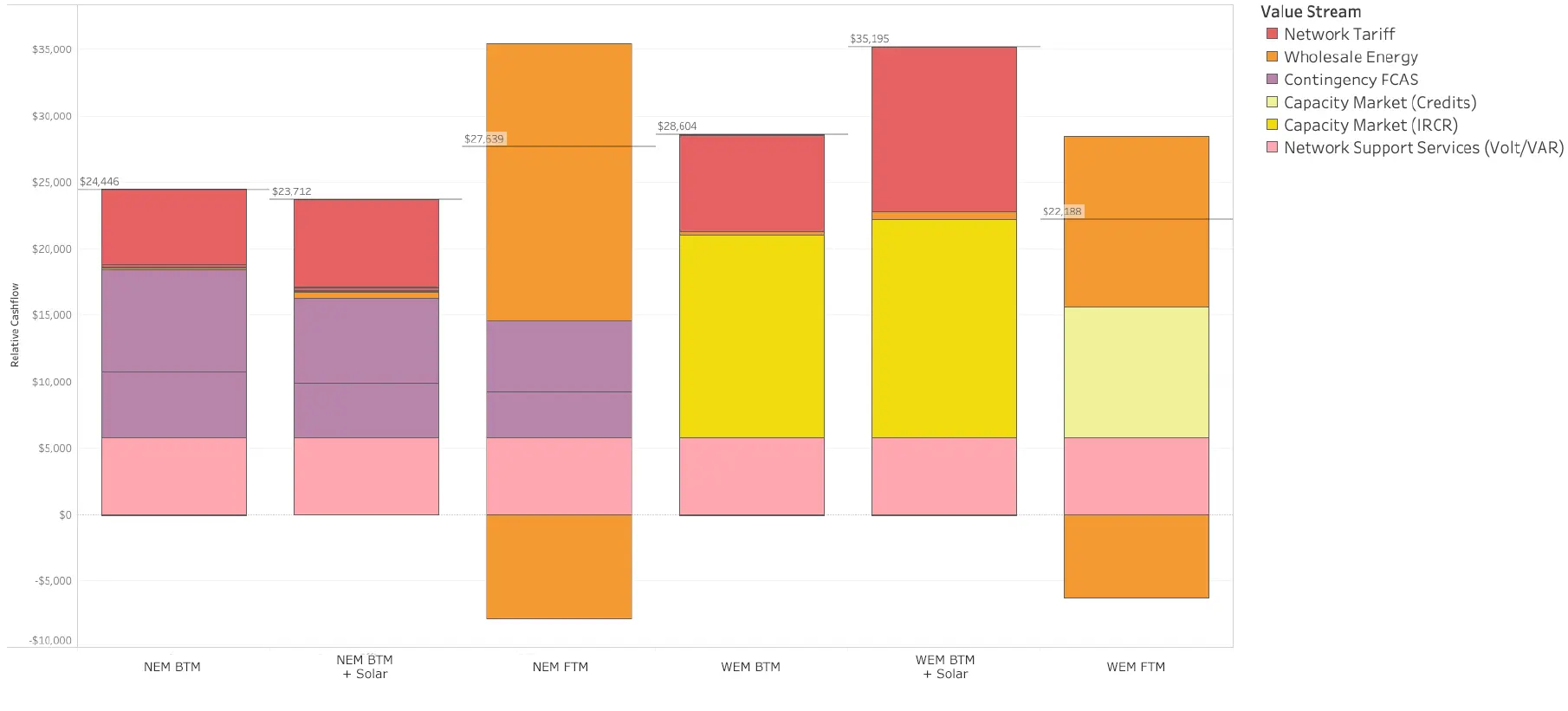
The debate often focuses on which location delivers the best return. We need quantitative analysis to move past rhetoric. Experts used digital twin software to simulate BTM and FTM assets. The simulation ran across six different scenarios. Three scenarios used the Wholesale Electricity Market (WEM) in WA. The other three used the National Electricity Market (NEM) on the East Coast. These markets operate very differently. This difference greatly impacts how batteries capture value.
Key Simulation Findings
Scenario 5 delivered the highest return. This involved WEM BTM storage co-located with solar. Reduced network charges and mitigated IRCR costs drove the value. Adding solar created a “peakier” load shape. This helped the battery reduce network demand charges more effectively.
The FTM asset in the NEM performed best among FTM options. Wholesale arbitrage created the winning difference. The NEM is a much more volatile energy market than the WEM. This volatility creates more arbitrage opportunities. The NEM’s contingency FCAS provided similar commercial benefits to WEM’s Capacity Credits.
Battery Health and Workload
We often overlook battery workload. Like the battery in your phone, lithium-ion storage degrades over time. Hard work leads to faster degradation. This includes frequency and depth of charge/discharge. Vendors typically warrant products by cycle count or total energy throughput.
The simulation tracked battery health and use. Batteries chasing wholesale market benefits worked continuously. Arbitrage opportunities always exist. BTM assets focused on network costs worked only a fraction as hard. BTM batteries co-located with solar worked slightly harder due to self-consumption needs.
This quantitative analysis provides important insights. The best placement depends on specifics. Market jurisdiction matters greatly. Network tariff structures are also critical. For BTM assets, the site’s underlying load shape is key. Do your own research (DYOR). Access to good simulation tools helps optimize these projects. If you are ready to invest, please Shop Our Products today.
Reference: Inspired by content from https://www.gridcog.com/blog/maximising-battery-value-a-commercial-analysis-of-front-of-meter-vs-behind-the-meter-storage.